Monday, December 12, 2011

Brown Creepers

Although the park is pretty deserted by now, a few hardy souls remain. Crows and Starlings are the most numerous. Interestingly, November, December, and January are about the only time of the year that I see Starlings in the park even though they're around the area year round. Juncos are still around, though not in the numbers they were a few weeks ago. And of course the regular Chickadees, Downy Woodpeckers, and Nuthatches remain.

Every now and then, a Brown Creeper or two shows itself. This morning, a pair of them were foraging on the cottonwoods on the north shore of the lake. They're difficult to see because they're so well camouflaged, but if you keep your ears pricked for this high-pitched noise, you may be able to catch a glimpse of one as it probes the trunk of a tree:

Direct link to mp3

Thursday, November 17, 2011

Redpoll

A welcome visitor from up north showed up this morning at the north end of the lake: the first Common Redpoll I've seen in the Twin Cities area in at least 3 years.

Common Redpoll
Common Redpoll
Common Redpoll
Common Redpoll
Common Redpoll

These little northern finches are relatively common in the wintertime in northern Minnesota, but they don't show up this far south every year. They tend to come south in big numbers only in years when there's less food for them to eat up north. I hope this means that we'll see more of these guys throughout the winter.

This solitary female Redpoll was feeding in the shoreline vegetation on the north side of the lake with a mixed flock of House Finches, American Goldfinches, and a couple of late Song Sparrows. She was not bothered by me in the least (as you can probably tell by how close she let me get for the pictures above).

Thursday, November 3, 2011

Shoreline Burn

The park board was doing a controlled burn of some of the shoreline vegation around the lake this afternoon.

Controlled Burn

I was pleasantly surprised to see a bufferfly still around, even if it is a common one. I believe this is a Clouded Sulfur, though it could be another type of sulfur.

Clouded Sulfur

The lonely American Coot that's been on the lake for the last 2 weeks or more hasn't left yet.

American Coot

Coots certainly aren't rare around here, but they don't often show up in the park. In fall, we generally get a couple of single birds that seem to have lost their way. In larger lakes nearby, you'll often see large rafts of coots numbering in the hundreds or thousands at this time of year.

Wednesday, October 26, 2011

Backyard Waxwings

Speaking of Cedar Waxwings, here's a shot of my backyard bird bath from over the lunch hour today:

Cedar Waxwings

Migration wind-down

The bulk of migration has passed by now. There are probably a few ducks and geese that may come through yet, but by-and-large the warblers are gone, and even the sparrows are mostly gone for the year. From here on, it'll be mostly the year-round residents (Chickadees, Crows, Downy Woodpeckers, etc), and possibly a few northern species that come down to our latitude for the winter.

Purple Finch (female)
Female Purple Finch
by Syd Phillips (CC BY-SA)

In the last category, I spotted 4 female (or juvenile) Purple Finches this morning. The similar House Finch is regular year-round, but this is the first time I've seen Purple Finches in the park. Hopefully a rose-colored male or two will show up to join the brown females; perhaps they'll even stick around through the winter.

This past week has also been a good one for migrating Cedar Waxwings. There have been roving gangs of 30 or more waxwings hanging around the juniper trees in the southeast corner of the park (and in other spots as well). Also of note: An American Coot has been hanging out near the dock behind the park building, and there are still a couple of Double-crested Cormorants hanging out on the island.

Monday, September 26, 2011

Turtle Hatch

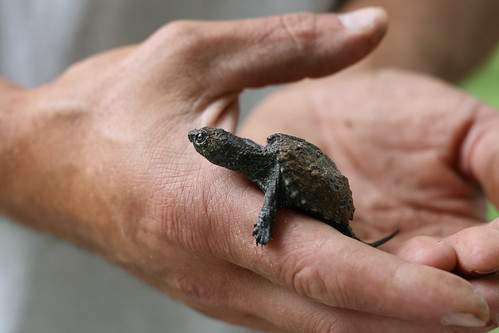
Over lunch hour, I was walking around the park, as usual. On the upper level near the tennis courts, a man approached me and excitedly showed me a baby snapping turtle he had discovered on or near the sidewalk. It was probably about 3 inches long, half of which was tail and looked just like this:

baby snapping turtle by Elizabeth Weller - BY-NC-ND

The man was afraid that the baby snapper would get trampled (not by turtles), so he scooped him up for a free ride to the lake. Apparently the turtle had been found very close to the spot where I met him, so there may be more baby snappers emerging from a nearby nest over the next little while. If you're walking or biking on the upper level of the park near the tennis courts, keep your eyes open.

Fall is officially here. Both according to the calendar and according to the birds. White-throated Sparrows (my official herald of fall) have begun to pass through the park, as have decent numbers of Yellow-rumped Warblers and Ruby-crowned Kinglets. Large flocks of Chipping Sparrows this morning also signal southern sparrow movement. I'd have been lucky to see one or two of them a week ago. Herons have become scarce in the last a couple of weeks, and a Pied-billed Grebe has been on the lake occasionally.

Tuesday, September 20, 2011

125

After a few more new birds spotted this fall, the park list is up to 125 different species. That's not bad for a park in the middle of the city that's not exactly managed to be a natural area. It shows that there can be a lot of wildlife around even when people don't realize it. On the other hand, on any given trip to the park, you're not likely to see very much variety; it's only over repeated trips that you're likely to see anything other than the most common birds.

The number of individual birds migrating through the park this fall has seemed a bit low, but the variety has not been too bad. Thus far this fall, I've seen 17 different kinds of warbler at the park. Ring-billed Gulls are increasing, and this morning I watched a Mallard steal a meal from a gull. I'm not entirely sure why the Mallard wanted the tiny bullhead; it didn't seem to eat the fish, which is unsurprising. I had expected the gull to put up more of a fight, but it just walked away.

I also watched a Cooper's Hawk make a couple of unsuccessful passes at a squirrel that didn't seem overly bothered by the encounter. In the past week, I've seen up to 5 Cooper's Hawks in the park at a time; small groups of juveniles getting ready to head south for the winter.

In addition, a female Northern Shoveler has been hanging out among the mallards for the last couple of days, and I saw my first Ruby-crowned Kinglet of the season a few days ago. I'm still waiting for the first migratory sparrows to show up. Here's to hoping that the fall doesn't pass too quickly.